Readings: Numbers 21:4-9, 1 Corinthians 2:1-5, Matthew 5:8-12.
The days roll on, and time unfolds the secrets held in the hearts of all peoples on earth. And what is it we see at this moment in the world? There is much death and destruction, disaster and ruin, some of which cannot be attributed to our continuity with nature and the animals; for animals are amoral, and some of what we see reaches into the depths of depravity.
In our little refuge, here in the Cathedral, the religious task we undertake is more than habit: it is a conscious use of our freedom to do again that which gives gratitude and praise to God, the necessary cause of our existence and our being here in the world, now, in these times.
What we see in our first scripture today is a tale of the first people who were saved by grace being led by Moses through the wilderness. From the high place of the mountain top they have descended spiritually back to the beginning—to Genesis. They have descended back into the sinful likeness of the first human made from the dust.
They who have witnessed mighty power and great deeds, so that they have the freedom to worship—they believe in God; they know He goes before and behind them in pillars of cloud and fire. Yet still, in their fallenness, in our fallen world, they grumble against God.
Looking for comfort, they have forgotten God’s goodness and great love for them. Without the indwelling of the Spirit there is impatience and despair. Without prayer and dialogue with God—for the people were afraid and elected Moses to represent them—without this direct encounter their hearts are hard, and the Word is written on stone tablets: near, and yet so far.
Faith—the trust in and dependence upon what is not yet seen but is hoped for, longed for—just as we thirst and hunger for food in a desert, do we have this same desire and give our attention wholly to God? We need food to live, yet upon it the life of the soul does not depend. Instead, we consume the bread of heaven, the Word made flesh, to be transformed inwardly.
God said to the woman, Eve, after the fall, there would be enmity between the offspring of the ancient serpent and hers. Here, in the desert, her offspring are revealing what is within the heart, and God sends the snakes to remind them of the curse: that the first humans brought death into the world through the corruption of their freedom to turn toward or away from Him. And in this suffering they recognise the consequence of sin in death; they are sorry and ask for the intercession of Moses to save them.
The bronze is symbolic of fallen humanity’s body and soul—an alloy of elements forged and created from the dust by our hands, our sinful flesh that must be crucified. And so this bronze snake is a type that points forward to Christ, for it was foretold in different ways that our sinful flesh would be put to death, that salvation would come by death upon a pole.
Yet through this death our flesh is raised up too. For our souls clothed in darkness, the light has come for us to throw off this darkness… just as we long in winter for the sunshine of summer, for under a summer sun we are clothed in this beautiful, life-giving light.
We were given bodies in the beginning; there is nothing inherently wrong with bodies. Our bodies are cleansed through our baptism: in His death it is crucified with Him, and in His resurrection we too shall have life eternal.
It is by the removal of the stain of original sin that the body meets once again with the divine breath of life that is in each one of us, speaking gently to our hearts, silently whispering that we may live with Him in this world of trouble and strife.
The bronze snake, therefore, is an outward and visible sign of our salvation through His grace and our repentance; for we must give consent and participate in this repentance—not by appearances but by an inward renewal of our hearts. We eat the Word, just as the prophets and apostle ate the scroll; the word is sweet in the mouth yet bitter in the stomach.
To hear is one thing, to speak is another, but to live and move and have our being as a light within the world is quite another still.
What we speak comes back to us as judgement, for our thoughts, words, and deeds are written down; nothing is hidden. Are we searching for life—real life in God? Can we go against the ways of the world to become lights in a dark place?
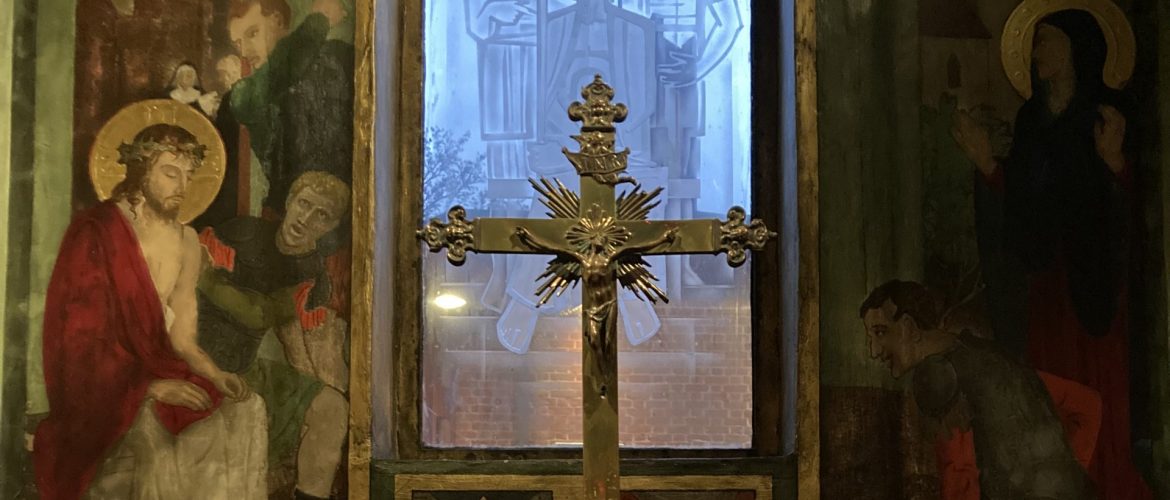
The wisdom of God saves His people: they turn to Him, look up at the bronze snake on a pole, and are saved—just as we now look to the cross, to Jesus upon the cross, the Lamb of God by whose blood we are saved. The work of salvation is done. And not by our words, our thoughts, or works are we saved, but by our repentance.
We are justified by grace through a living faith—not by faith alone which is dead, or by our own merits, but through our repentance, which unites both our faith and our works in response to God’s grace—for “out of the abundance of the heart the mouth speaks” (Luke 6:45).
Neither do we work for our salvation, as it is accomplished by God’s grace through Christ’s death on the cross; He is our righteousness, having taken our sins upon Himself once for all. We are called simply to repent and believe in the Gospel. This turns us from passive acknowledgement into active trust that bears fruit, repentance a unifying dynamic.
For even the demons believe—and the devil himself stood before the Lord in the company of angels (James 2:19; Job 1:6, 2:1)—what good is their belief without repentance?
“The time is fulfilled, and the kingdom of God is at hand; repent and believe in the gospel.” (Mark 1:15).
The mountain was made low and people met with Jesus on level ground, face to face. Does our heart long to see Him face to face? Our liturgy has been designed to make the whole of this historical journey real and tangible—one that we can taste, see, hear, and touch. By the movements we make here in this service we say we are sorry and pray; we clean ourselves up from the week, days, and hours past; we ready ourselves to be illuminated by the Word; by the Word we are filled and satisfied; and by His death we participate in the sacrifice of His body and blood. His life and witness reach across time and beyond to be with us, to be here in our hearts—to let the shadow of death pass over.
We participate in this world by our own sacrifice, for the truth that has taken root in our hearts plants us into a divine mystery that speaks from beyond the clouds.
Blessed are the pure in heart, for they shall see God—in our common humanity, in our shared needs, He is there; in the noumenal realm, beyond our sense experience, His appearance in the mystery of presence felt deeply as a burning in our hearts—that burning love which reminds us that for it we would do everything we possibly could to care for another in love.
Blessed are the peacemakers who live in the eye of the storm, in the stillness of God while all rages outside: “Do not fear, I am with you,” He whispers.
Blessed are the persecuted, the ones who hold fast to the mystery held in His eyes; in the furnace of love we do not look away.
Blessed are we when we are insulted for righteousness’ sake, when someone does evil, declaring their own truth that is relative to their desires and their longings in the world, for things of the world rather than for the unchanging truth. In these times let us hold on to this eternal truth to which each of us is called—that is the love of Jesus Christ: an unfathomable beauty, truth, and goodness that we can only reach out for and touch in the material world through our hearts and minds raised to Him who hung upon the cross.
Therefore, this Lent may we look toward the cross with love and sorrow, with gratitude and humility, with enduring faith and repentance.
Amen.